Posts mit dem Label The Divine Comedy werden angezeigt. Alle Posts anzeigen

Freitag, 1. Juni 2012

Plans for June: A Victorian Celebration

Like every single other person around here on the bloggosphere I am taking part in Allie's Victorian Celebration this June and July (Allie: thanks for hosting by the way!).
I have been looling forward to it for months now, because what could be more awesome than a summer full of Victorian Literature?
Unfortunately I was quite disappointed with the result after having piled up all Victorian books hidden on my shelves: there are only five I haven't read yet! These are pretty basic titles, so please keep in mind that I never consciously read a single classic until last November before laughing at me. Let's start the list with Dickens who is an obvious choice but also an intimate friend of mine:

  • Oliver Twist by Charles Dickens (I am a little afraid of this one because it is one of his best-known works and I usually tend to prefer those books of an author which are not so appreciated in general.)
  • A Study in Scarlet and
  • The Adventures of Sherlock Holmes by Sir Arthur Conan Doyle (Exciting because I love Sherlock)
  • Wuthering Heights by Emily Brontë (this is technically a re-read because I once read a simplified version, but it had only 70 pages and I don't remember anything except for desperate love)
  • The Picture of Dorian Gray by Oscar Wilde  (Surprisingly, I have nothing to say about this one, but I am not especially looking forward to it.)
Additionally I have The Fall of the House of Usher and other Tales by E. A. Poe waiting on my TBR pile, but since some of these tales were written before the Victorian Era it will probably remain there.
I would like to finish all of these titles during the event because I really want to focus on Victorian Literature. If things go very well I will even make a huge Victorian Amazon order and post a new list at the beginning of July.

However, what I will not abandon during the Victorian Celebration is Les Misérables. I am finally on schedule with the readalong again and I am enjoying it. Also, the lovely trailer for the new movie just came out and motivated me extremely. 

Probably I will continue with the Divine Comedy too, so I would like to finish Purgatorio in June. That way I will always have something to turn to when corsets, street children and Victorian psychopaths start getting on my nerves.

Which Victorians have you chosen? Anything else on your nightstand for June?
I hope you all have a lovely month and better weather than in Austria!

Donnerstag, 31. Mai 2012

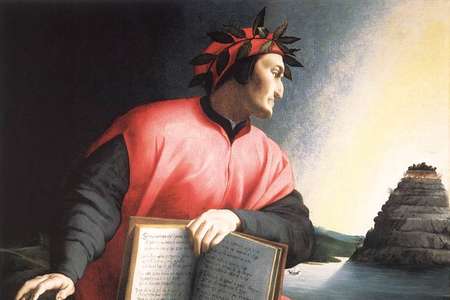
Inferno by Dante Alighieri


Inferno tells the story of Dante's descent to hell and his journey through its nine circles. The book was written at the very beginning of the 14th century and is the first part of the famous Divine Comedy.
It is also the most impressive work of literature I ever read.
"I found myself within a forest dark, for the straightfoward pathway had been lost. Ah me! How hard a thing is to say, what was this forest savage, rough, and stern, which in the very thought renews the fear. So bitter is it, death is little more..."
I will probably not win a prize for originality by stating that Dante's language is absolutely sublime. I am not even a great fan of poetry, but these lines had something to them that made me read on and on, sucking in the colourful images they created. It was very strange, although I am not really religious these words evoked in me the vague feeling of something grand.
What I did not expect though was the vividness of the writing; hell arose before my eyes as if I was wandering through it myself.

Dante's hell is an enourmous creation: diverse and detailed and absolutely terrifying. I can hardly imagine how long the planning phase must have been, for it is thought-out to the smallest detail.
For every sin the souls are punished accordingly, the fortune-tellers for example have to walk with their heads turned backwards because in their lives they tried to see the future when they had no right to.
I did not always agree with Dante's division into circles, for instance I found it unreasonable that fraud is punished more severely than murder and in my opinion some souls, such as astrologers and alchemists, but more than anything the virtuous pagans who committed no other sin than being born before the time of Christianity, ought not to be in hell at all. Also, looking at sins such as greed and anger I could not help asking myself if any of us would not end up in hell.
Those were the moments when I had to remind myself that Dante lived in the Middle Ages and that his view of life was probably completely different from ours. Nonetheless the knowledge that this book determined the human idea of hell for hundreds of years impressed me deeply and never really left me while reading.

A big part of the journey through hell is made up by the stories which the damned souls tell of their lives and crimes. I was astonished that these souls were not invented by Dante, but all either real historic persons or characters from mythology such as Ulysses. The person who is in fact the reason for the whole journey (she sends Virgil to Dante to save him after he had lost the right path) is Beatrice, who died very young and is the object of Dante's eternal love. I cannot wait to finally meet her, but I am afraid she will not turn up until Paradiso.  Whenever someone I knew appeared I was amazed: Sophocles for example, Brutus or Helen of Troy, but there were many Italian noblemen I had never heard of before and although their names were explained in footnotes I think a better knowledge of Italian history would make me appreciate the book more. Another thing that took me by surprise is Dante's criticism of the church; there are more than a handful of popes and bishops suffering in his hell.

However, what surprised me most is how political the Divine Comedy actually is. Obviously Florence was in terrible uproar at that time, with fights between two parties, the Guelphs and the Ghibellines. This conflict is featured prominently, probably because of Dante's strong involvement in it in real life. He was even expelled from Florence, his home which he (and many of the souls in hell) loved dearly and never returned to it until he died.

Did I understand everything I read? Certainly not. There were some lines whose meaning remained a complete mystery for me even though I read an annotated edition and others where I was not sure whether my interpretation was right or utter nonsense. I tried not to worry too much about that though: I know that I probably only understood a small percentage of the Inferno accurately, but I feel that the Divine Comedy is much too multilayered to be fully comprehended after  reading it just once. Most importantly, am enjoying it a lot, so onward, to the Mountain of Purgatory and into Paradise!

Donnerstag, 17. Mai 2012

Southwards

On the floor next to me is a half-packed suitcase filled with suncreme, swimsuits and my Italian textbook.
I myself am filled with excitement, because despite the fact that it's just a short trip and I will be back Sunday evening, I will still be on the road again and travelling always amazes me.
My mama, my little brother and I are spending the long weekend in Grado, Italy, to take a short break from our lives which have been more than busy recently. Grado is a little town situated on a peninsula of the Adriatic Sea and famous for its beautiful historic centre. It's in the north-east of Italy and only about three hours' drive away from here which is a reason to worry because the weather here is not too fine at the moment. Hopefully it will be better once we're there! Anyway, even if we probably won't get to swim much it will still be fabulous to relax on the beach and enjoy the Mediterranean lifestyle.

For my packing (of which a great part still has to be done I'm afraid): I am taking E.M. Forster's A Room with a View with me, because what could be more appropriate than reading the story of a girl touring Italy while you're in Italy? It's my first Forster and I have great expectations, so I hope I won't be disappointed.
Another book I'm bringing I will be basically taking home, for it is The Divine Comedy, Italy's most successful work of literature ever. Contratry to A Room with a View I have already started Dante's magnum opus, in fact I am almost through with Inferno, and it has sparked a desire in me to improve my very, very poor Italian in order to be able to read the original. I am usually not a great fan of poetry, but Dante's language has something to it that makes me turn pages as anxiously as if I were reading a cheap romance. 
Nonetheless, reading about a travel through hell in the sun on the beach surrounded by happy tourists will be an experience all of its own and so I am not sure how much I truly will progress with this one.

I wanted to take Les Misérables with me since I completely neglected it after my disappointment with it in April, but then I decided that it was decidedly too heavy to be carried in my handbag. Instead I have chosen a book which definitely belongs to the "guilty pleasure" category: it's Blood of the Fold by Terry Goodkind and part of his Sword of Truth series. As you may have guessed from the title it is high fantasy, and a very good example of that too. I think after travelling through medieval poetry about the underworld and Forster's social critisism I can afford to delve into a novel full of swordfights, epic magic and forbidden romance.

My open suitcase is starting to alarm me, so I am going to finish packing now. I'll be back Sunday afternoon, hopefully with lots of beautiful memories. How about you? Any holiday plans coming up? Did you read A Room with a View or The Divine Comedy? If yes, did you like it? 
I am wishing you all a nice weekend, whether you're staying a home or not!

Samstag, 12. Mai 2012

The right Book

I am sitting here surrounded by piles of books. There are at least thirty books I haven't read yet stacked on my desk, on my cupboards and even on the floor; they range from Oliver Twist to The Catcher in the Rye and I have bought all of them because I knew I would enjoy reading them. How come then that during the last few days I picked up every single book, started reading it and found not one that appealed to me?
Yesterday I ventured out at my parents' shelves, almost desperate to find a book I would want to read and came across The Divine Comedy there, which instantly fascinated me, so my dilemma is already sorted out, but it left me wondering why some books sometimes just don't feel right.

I think everyone has already experienced that a book which seemed boring or even bad at a certain point in your life turned out to be absolutely amazing and intriguing when you gave it another try some years later, or the other way round. Human beings tend to be only interested in things they can at least remotely relate to and usually we like a book the better the more we can identify with its characters and their situation. A very good example of that is my experience with Jane Eyre, which came just at the right time: for most parts of it Jane is a young woman, strong-willed but socially unskilled and unversed in interpreting her own feelings and those of others. I doubt I would have loved this book so much if I had not been able to relate so completely to her position.
We do not stop to develop and mature until we die, in fact at fifty years we are not even the same persons we were when we were twenty and so it is obvious that one and the same book affects us differently at different stages throughout our lives.

There is more to it, though. A good book creates a certain atmosphere, it evokes a special feeling within us. It has a distinctive ambiance which makes us feel like coming home whenever we turn its pages after having read it once. These feelings are hard to put into words, but I am convinced that every passionate reader understands what I mean. Sometimes a novel fails to captivate us simply because it is not in line with our current mood.
Even the season makes a difference at times, in summer I am usually drawn to other books than in winter.
Another important factor is the amount of concentration we are prepared to spend on a book: now and then we want a light read because we only want to drift with the flow of a story without anylysing too much, but at other times we need something demanding that fully absorbs our concentration.

Not all is lost if we surprisingly dislike a book we expected to love, sometimes it is just that the time is wrong. For now I am content with The Divine Comedy and I know that soon I will again be in the mood to pick up a book I dismissed as boring only yesterday.